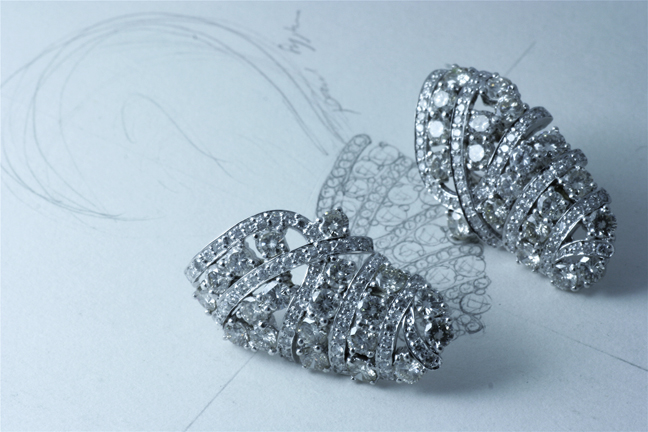
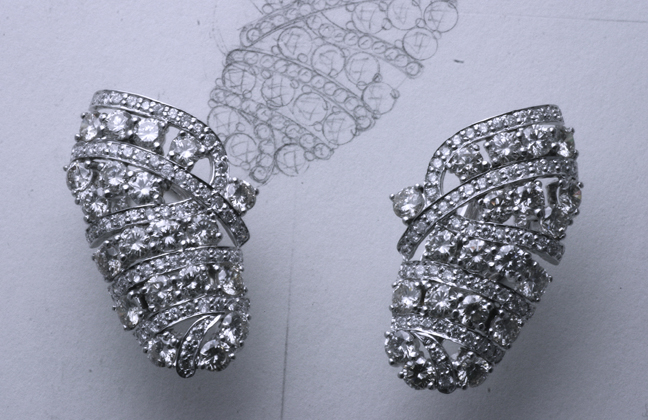
For a friend's wedding, I reworked some heirloom diamonds into this great pair of earrings. I decided to have them rest over the entire bottom lobe of the ear and wrap them around a bit on the edges. Diamond crusted earlobes. Sure to have made a few double-takes.
Given how popular white gold has been for the past decades, it's been quite exciting to be doing more and more yellow gold pieces at present. My latest project was this wide Romanesque hammered cuff with diamond accents; and earrings using the same motif. Yellow gold just has that certain rich warmth to it that you can't get from the other, sometimes antiseptic looking, white metals. Try visualizing these same pieces in white gold. Not quite the same effect, right?
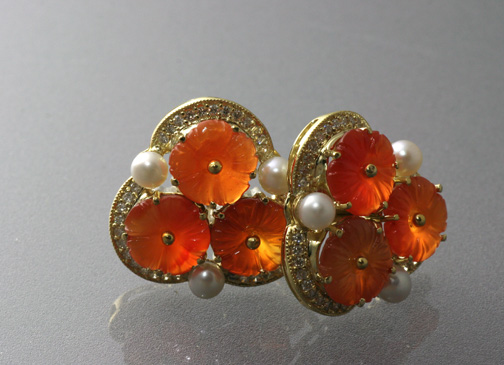
Here are earrings of carved carnelian flowers with diamonds and seed pears set in yellow gold. Carnelian falls under the chalcedony (kăl-sĕd'n-ē) species which is related to quartz. Varieties of chalcedony are usually differentiated by color; multi-color banded chalcedony are usually labeled as agate, black and white banded ones are called onyx and orange ones are called carnelian. And here are some exceptional ones with vivid color, waxy texture and translucency.
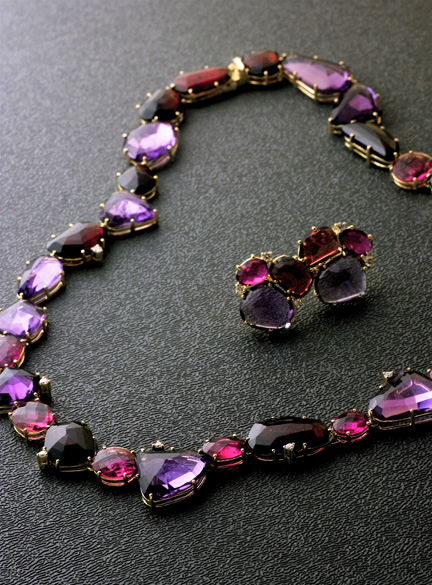
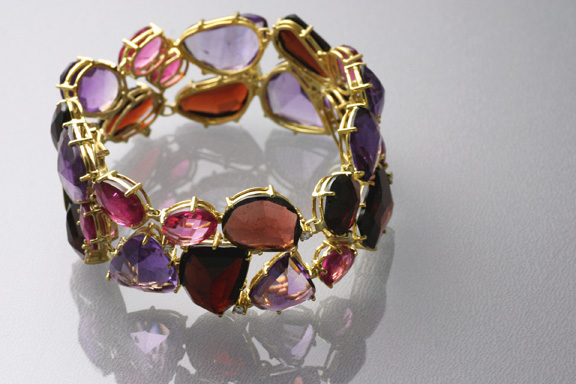
Here's a suite of rose cut amethysts, intense pink tourmalines, pyrope garnets and diamonds set in yellow gold. A great combination of interesting shapes, subtle brilliance and deep hues.
This was a project based fundamentally on color. I was tasked to create these based on purples, pinks and dark reds and was able to source these interesting free-form rose cut stones for it. Rose cuts were primarily developed for diamonds in the 1500's and were considered cutting edge at that time as it proved to give a more brilliant stone compared to older style cuts. From the top they resembled rose buds, hence the name. The brilliant cut (which had more fire and sparkle) was developed some time in the 1700's and paved the way for the modern round brilliant stones we're familiar with today. Whereas brilliant stones do create some sharp sparkle, sometimes its great to see some stones with soft, broad flashes too.
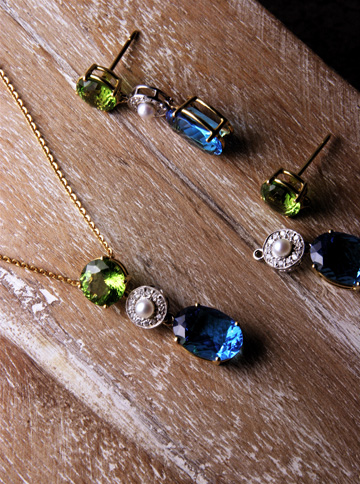
Peridot studs with detachable blue topaz, seed pearl and diamond drops. Just one of the few handpicked items (by Mrs. T, nonetheless) now availabe at Accessory Lab at The Powerplant Mall in Rockwell.
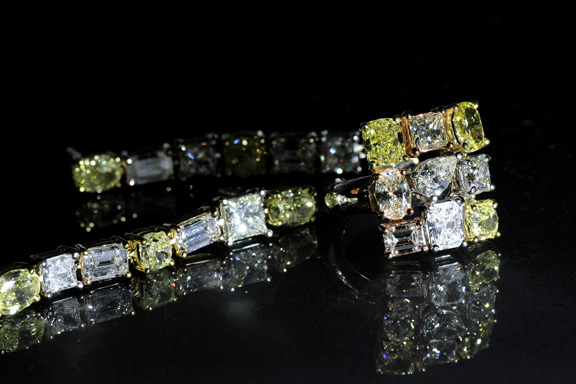
Conventional wisdom states that white, or colorless diamonds, are best. But there are exceptions; and they are known as fancy colored diamonds. Technically any other color than clear or white, and its range of yellowish or brownish tints are labeled "fancy" colors. Thanks to J.Lo's huge pink engagement ring Et al... we probably have an idea what colored colored diamonds are. But how would one know what they actually look like? The colors will definitely be unmistakable. The combination of the vivid hues and the characteristic sharp brilliance of the diamonds make it truly stunning to look at.
Shown here are rings and drop earrings in vivid yellow, light pink and E-F colored diamonds (over 12 carats in total) in tri-color gold setting. So nice that the ring didn't quite make it to the store display. Oh lucky you.
Gold in pure form is usually too soft to be used as jewelry; hence the need to alloy with different metals to make it more durable. Karat denotes gold's purity (usually confused with carat; meaning diamond weight). 24K denotes 24/24 parts pure gold = 100%. 18K denotes 18/24 parts pure gold = 75% or 750. 14k denotes 14/24 parts pure gold = 58% or 585. So on and so forth...
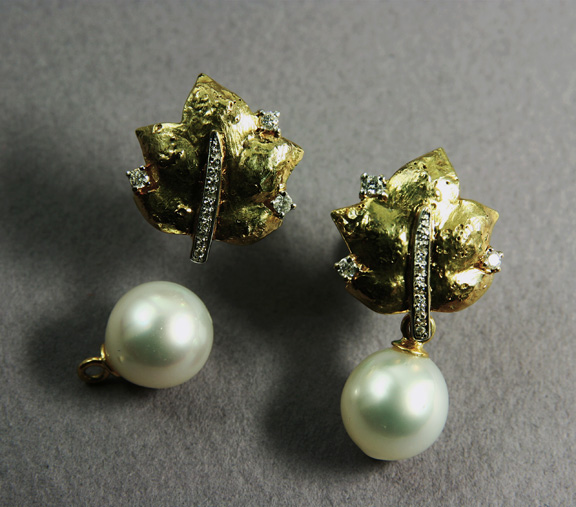
And, yes, there is green gold. You get different colors of gold depending on the type of alloy you mix in with pure gold (which is a rich yellow). More copper leads to pink or rose gold, more iron produces black gold and more nickel produces white. The special alloy used in making green gold is silver. It produces a nice subtle tint and deepens over time as it develops its patina.
Shown here are hand-textured green gold maple leaf earrings with diamonds and detachable south sea pearl drops.
Amethysts are actually purple/violet colored quartz (In the same way orange quartz are commercially known as citrines). Technically, any other colored quartz would be labeled by its color e.g. pink quartz or green quartz, etc..
But I guess to make the stones sound more marketable, the names are changed up a bit; as labeling yellow quartz as "lemon quartz", clear/colorless quartz as "rock crystal quartz" and brown quartz as "smoky quartz". And then there are the recent transparent pink and green ones recently labeled as "pink amethysts/green amethysts". I suppose it does sound a bit more interesting; and confusing as when one mentions amethysts, you'd expect to see a purple/violet stone.
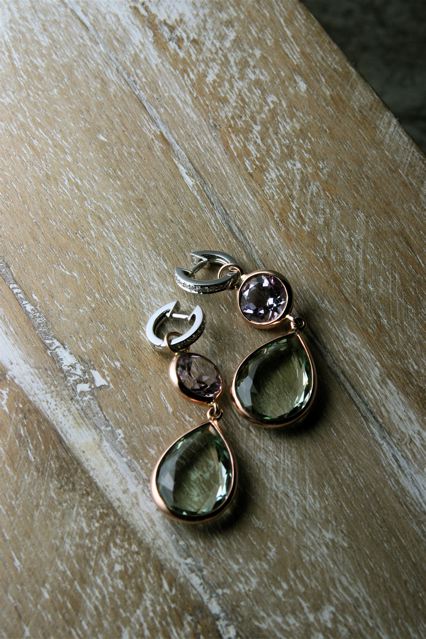
NEVERTHELESS, upon seeing these special cut pink and green amethsyts...err....quartz..... I knew they'd make for some attractive looking earrings. Sometimes its just so easy to get lost in the jargon.
Detachable pink and green amethyst drops bezel set in rose gold; diamond set hoops in white gold.
I love how pretty straight-forward this piece is; highlighting only the gems used (...which should, bottom-line, highlight the wearer). Colorless rose cut sapphires and diamonds set in white gold. The pear shaped drops are detachable just in case you want to change it up a bit. It's a real head turner.